Skip to content
You are here

The Journal · Rings & Jewellery · How often should a jewellery valuation be updated?

Rings and jewellery

How often should a jewellery valuation be updated?

Every two to three years is the general rule, sooner after a remodel or a sharp move in the rand. What actually goes stale, and what an old valuation can cost you at claim time.

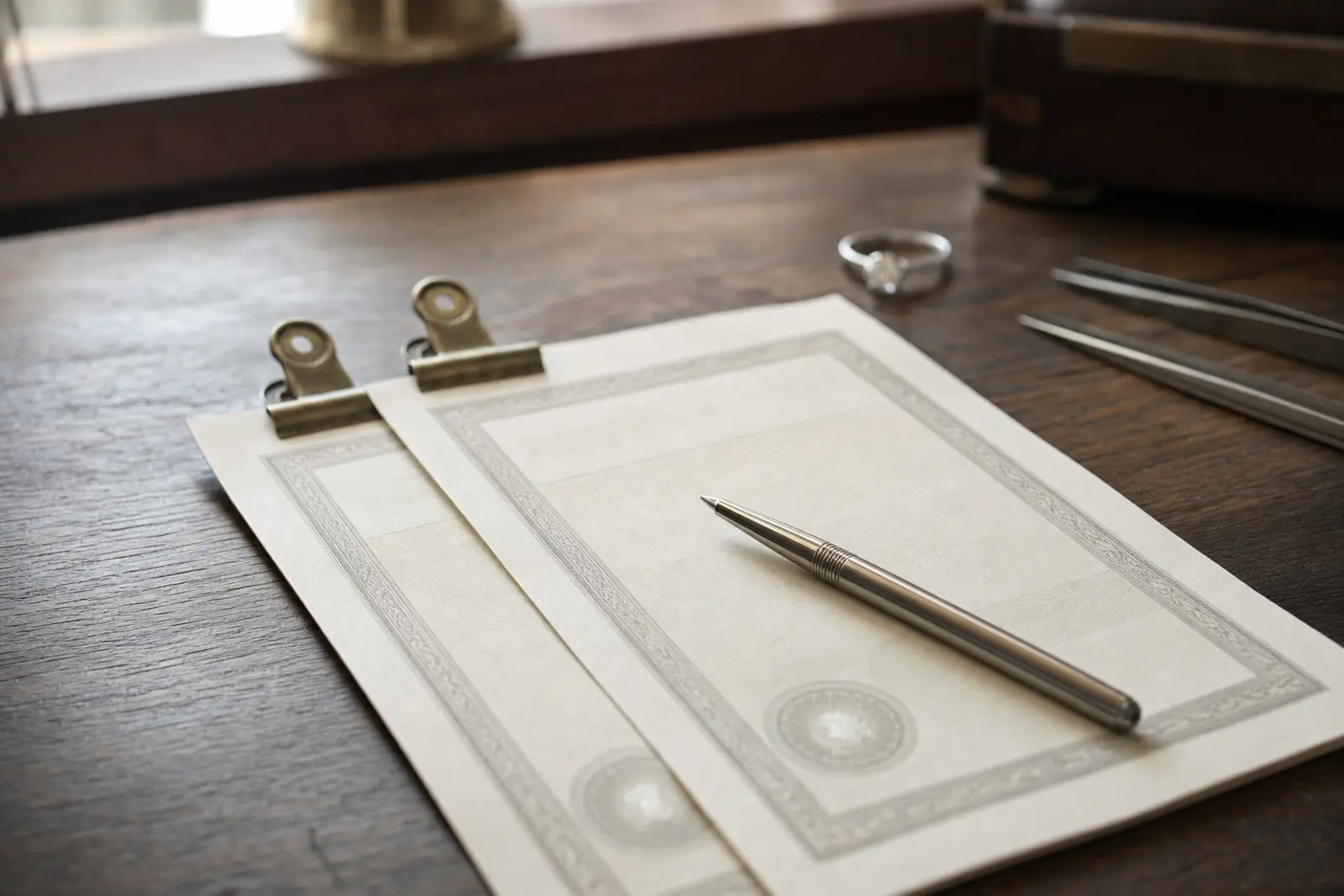
A valuation certificate and an older one clipped together on a bench with a pen resting on top

At a glance

Routine update
Every two to three years
Update sooner if
The piece has been remodelled, resized or repaired
Send the new copy to
Your broker, not just your own files

Two to three years is the general rule for updating a jewellery valuation, and the reasons for it have less to do with the ring itself than with what has moved around it in the meantime.

The case for every two to three years

A piece can sit in a drawer for years without a mark on it and still be significantly under-insured, because the number attached to it in a policy is a snapshot from whenever it was last valued. Two to three years is a sensible outer limit for most pieces, closer to two if the piece is particularly valuable, or if there has been a lot of movement in metal or stone prices since the last valuation. A ring bought a decade ago and never revisited is the clearest example of how far a policy figure can drift from what the piece would actually cost to replace.

What actually moves the number

Two things drift independently of each other and of the ring: the rand's value against the currencies gold and diamonds are priced in, and the underlying prices of those metals and stones themselves. Either can shift a replacement value meaningfully over a couple of years without the ring changing at all, which is exactly why an old certificate can understate what it would actually cost to replace a piece today. Neither movement is something a policyholder is expected to track personally; it is simply the reason a fixed figure from years ago stops being reliable.

After any remodel or repair

Once a ring is reset, has stones added or removed, or is resized significantly, the description on file no longer matches what exists. This applies whether the work was cosmetic or structural; any change to the weight, the stone count or the setting means the old valuation is describing a piece that, strictly, does not exist any more.

What an update actually involves

The process mirrors the original valuation: the piece is examined, weighed and photographed again, and a new certificate is issued with a current date. It is usually a shorter visit than the first time, since much of what needs recording is already on file and only needs confirming rather than establishing from nothing. Photographs are retaken even where nothing looks different, since comparing the new set against the old is often the easiest way to confirm that nothing has actually changed.

What happens if you claim on an old valuation

An insurer settling a claim against a valuation that is several years out of date may pay out at a figure that no longer covers what it would cost to replace the piece, or may simply query a document that looks stale. Neither is a good position to discover mid-claim. Keeping the valuation current is the whole of what prevents it.

Keeping copies

Once an update is issued, keep both a physical and a digital copy, and send the new one to your broker directly rather than only filing it at home. A valuation that exists but was never actually sent to update the policy protects nothing.

Routine cadence
Every two to three years
Always update after
A remodel, a significant resize, or stones added or removed
What drifts
The rand, and metal and stone prices, independently of the ring
Send the copy to
Your broker, not only your own records

Does the update need to come from the jeweller who made the piece?

No, any qualified valuer can carry it out. A jeweller with the original specifications on file can often work faster and confirm details more precisely than a valuer working from the piece alone, which is one advantage of returning to the same studio, but it is not a requirement.

What if I genuinely cannot remember when it was last valued?

Treat it as overdue and have it done now. An insurer is unlikely to accept an approximate memory of the date as satisfying a valuation or maintenance clause, so the safest assumption, if there is no record of a date, is that it needs doing.
Related jewellery guidance

The ring side of this decision.

The next step

Update the certificate before it becomes a problem.

A short visit to the Illovo studio brings the valuation current and sends a fresh copy to whoever needs it.

Keep reading

The next stage

All of Rings & Jewellery

Testimonials

In their words.

  • “I decided to get engaged while my lovely girlfriend went to the UK for a short trip and I used the time to get a ring made while she was away. Gavin and his team gave me great advice and freedom. They helped me create and design my own ring, and taught me so much about the choices I have. They made the whole process a fantastic experience and I will totally send my friends back for the one on one experience.”

    Willie NelFreelance filmmaker
  • “Gavin and his firm were recommended to us by a mutual friend. From the very first contact, Gavin conducted himself in a very friendly but professional manner. Gavin clearly demonstrated the love and understanding of his business. His attention to detail and willingness to listen to our needs was very reassuring. We are extremely pleased with the design, quality of our jewellery and the superb service. It was certainly one of the best shopping experiences we have had. Our friends have found Gavin amazing and are very impressed with their purchases. On purchasing diamonds, we highly recommend others to contact Gavin. We certainly look forward to doing business with his company for years to come.”

    Dusanka and Robert CosicWales, UK
  • “My experience with Gavin was nothing less than exceptional. He provided excellent customer service, quality diamonds, and competitive prices. He was very knowledgeable and an excellent teacher. I learned everything I needed to know before purchasing the right diamond. I would recommend him and his company to anyone considering the purchase of a precious stone.”

    Michael Zarrabi, M.D.Plastic and Reconstructive Surgery
  • “Great experience dealing with Gavin. I have had many good experiences dealing with Gavin. The jewellery and stones are breathtaking and very reasonable in price. The service we received was so efficient and good advice was given to us when choosing specific stones. We look forward to many more dealings with Gavin.”

    Daniel and Elise Boyer
  • “My experience with Gavin goes back some years. Not only have I and my wife been advised and purchased from the company; we have, in addition, successfully referred a number of our friends to Gavin. His knowledge, service and flexibility have ensured that we consult them on any occasion where we are thinking of purchasing jewellery.”

    Bernard FreemanCEO, European Healthcare Group PLC, London
  • “Gavin Ruschin has been my preferred supplier of diamonds and designer jewellery for the past five years. During this period of knowing Gavin, I feel extremely privileged to have a supplier of such character and integrity servicing me personally, my company The BLD Group and our clients. Gavin has through excellent service become one of the most credible suppliers on our books. His honesty, unconditional professional service, excellent pricing and pleasant manner have earned him the respect and reputation of the highest degree amongst my clients, which include professional sportsmen and sportswomen, leading business people and politicians.”

    Bruce V DavidsonExecutive Chairman, The BLD Group