An emerald engagement ring is a decision to prioritise a colour that nothing else quite matches over a stone that behaves as forgivingly as a sapphire or a diamond, and the honest version of that trade is worth hearing before you commit to it.
The colour, and the garden inside it
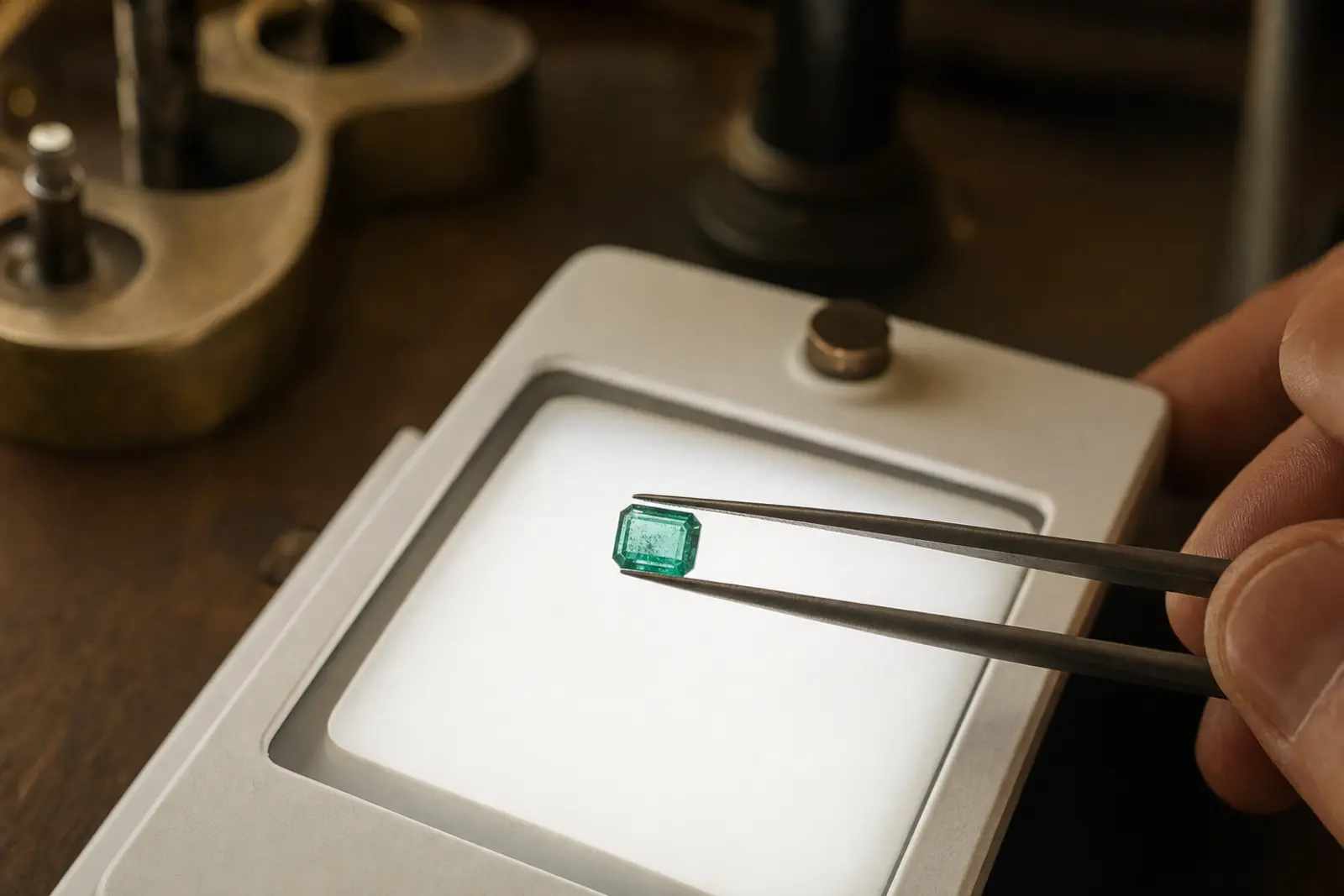
The finest emeralds show a pure, saturated green with real depth to it, sometimes leaning cooler and bluer, sometimes warmer, depending largely on where the stone formed. Almost every emerald carries visible inclusions, a mix of internal crystals, fractures and growth features collectively and rather affectionately known in the trade as the garden. This is normal for the species rather than a defect, and a completely clean emerald is unusual enough to be treated with some suspicion rather than delight.
What matters is how the inclusions sit and whether any reach the surface at a point that could catch on something. A stone with a dense but stable garden can still be a good choice; one with a fracture running to the girdle at an edge is a durability risk regardless of how the colour looks.
Oil and resin, and why the disclosure matters
Most emeralds are treated with oil or resin to fill the small surface-reaching fractures that are part of the stone's nature, improving clarity and, often, colour. This is long-standing, widely accepted practice, and it should be disclosed on the report and on the invoice without you having to ask twice. What is worth understanding is the degree: minor treatment is stable and common, while heavier resin filling can be more visible over time and is worth knowing about before you buy, particularly if the stone will be worn daily rather than occasionally.
Why the emerald cut suits the stone
The emerald cut, a rectangular step cut with trimmed corners, exists largely because of the material it is named for. Its broad, open facets and lower internal stress make it more forgiving to cut around an included stone than a brilliant faceting pattern would be, and its flat planes flatter the colour rather than breaking it into small flashes the way a round brilliant would. It is not the only cut used for emeralds, but it is the one the stone was built to wear.
Setting it to survive daily wear
Emerald is a seven and a half on the Mohs scale, which sounds respectable until you know that toughness, resistance to chipping rather than scratching, is the more important measure for a stone this included, and emerald scores poorly on it. A bezel or a low, protective setting is not a stylistic preference here; it is the setting decision that determines whether the stone survives being worn on a hand that does ordinary things. High claws on an emerald are a decision to accept a shorter working life in exchange for showing more of the stone.
Cleaning and care, specifically
- Never use an ultrasonic cleaner on an emerald; the vibration and heat can loosen or cloud the oil or resin fill.
- Clean with a soft cloth and lukewarm water only; avoid hot water, steam and harsh soap.
- Remove the ring before anything involving impact, chemicals or prolonged sun, including gardening, swimming pools and gym work.
- Ask what treatment your stone has and keep a note of it with the report.
None of this makes an emerald the wrong choice. It makes it a choice with a maintenance conversation attached, and most people who fall for the colour are glad to have that conversation rather than skip it.
I would never talk someone out of an emerald they genuinely love. I would talk them into a bezel, and into knowing what they are agreeing to wear.
Can an emerald engagement ring be worn every day?
With the right setting, yes, though it asks more care than a sapphire or a diamond would. A protective bezel or half-bezel setting, avoiding an ultrasonic cleaner, and taking the ring off for anything involving impact or chemicals go a long way. What it cannot do is match the carefree daily wear of a harder, tougher stone, and anyone choosing an emerald should decide with that honestly in mind rather than discover it later.
Why do emeralds almost always have visible inclusions?
It comes down to how the stone forms. Emerald grows under conditions that almost always trap other minerals and small fractures inside the crystal, unlike sapphire, which more often grows relatively clean. In the trade this is called the garden, and it is considered part of the stone's character rather than a flaw to eliminate. A genuinely clean emerald exists, but it is unusual enough that most buyers are choosing between different gardens rather than choosing whether to have one.