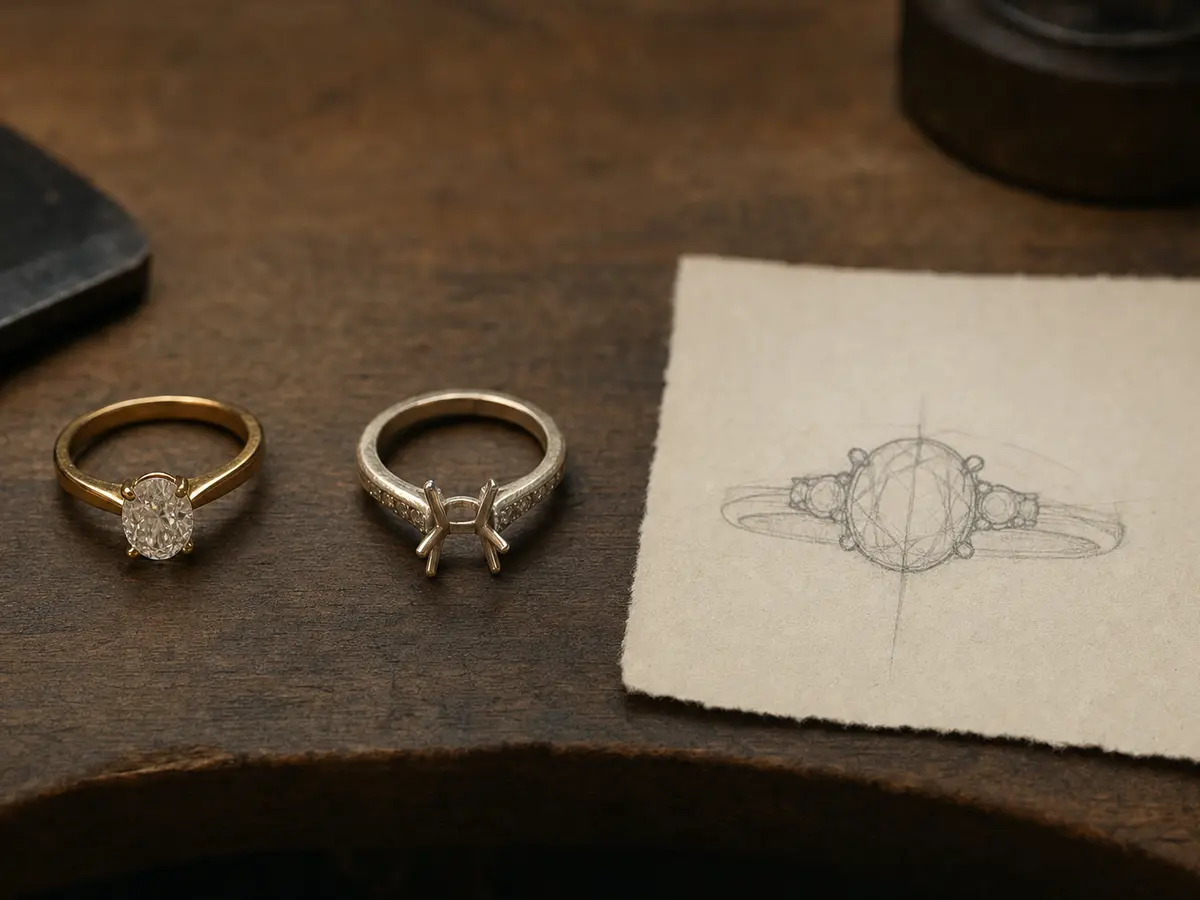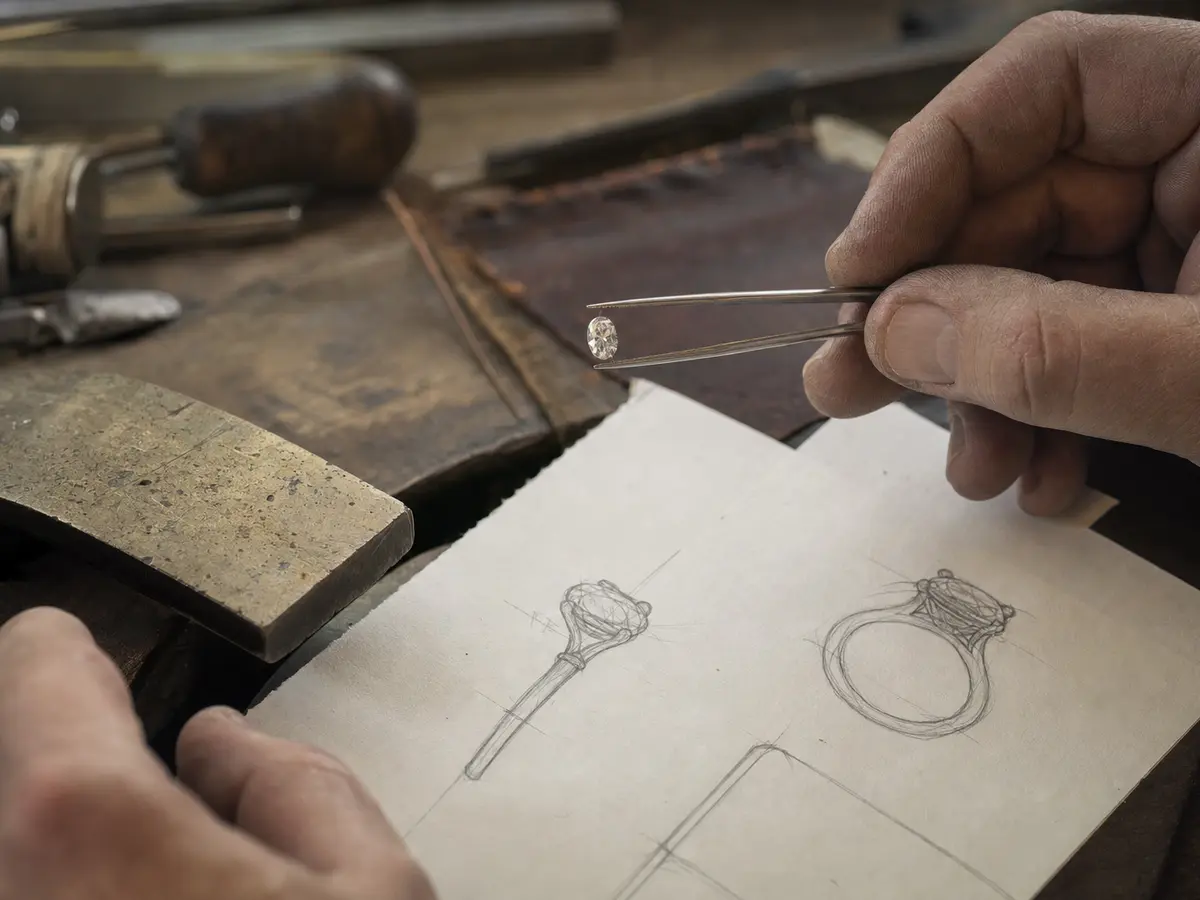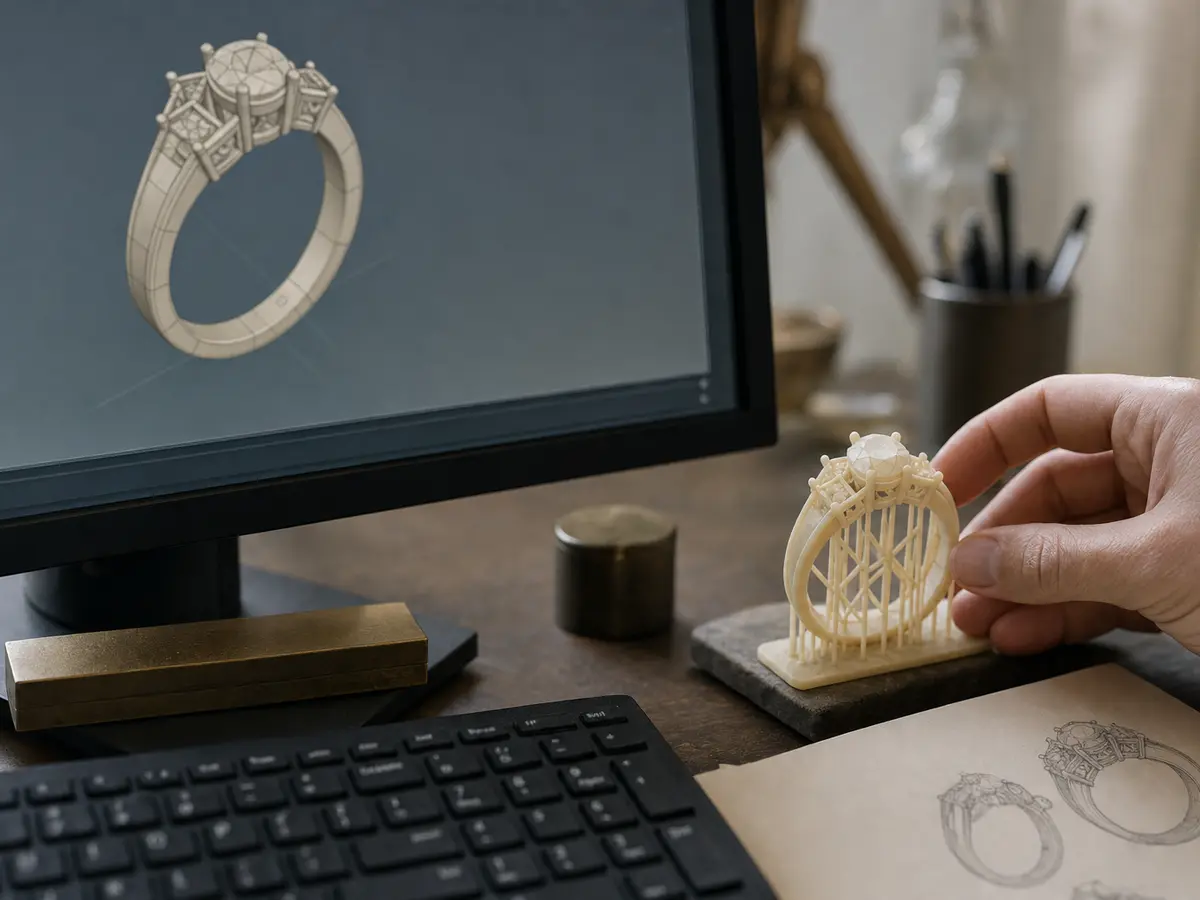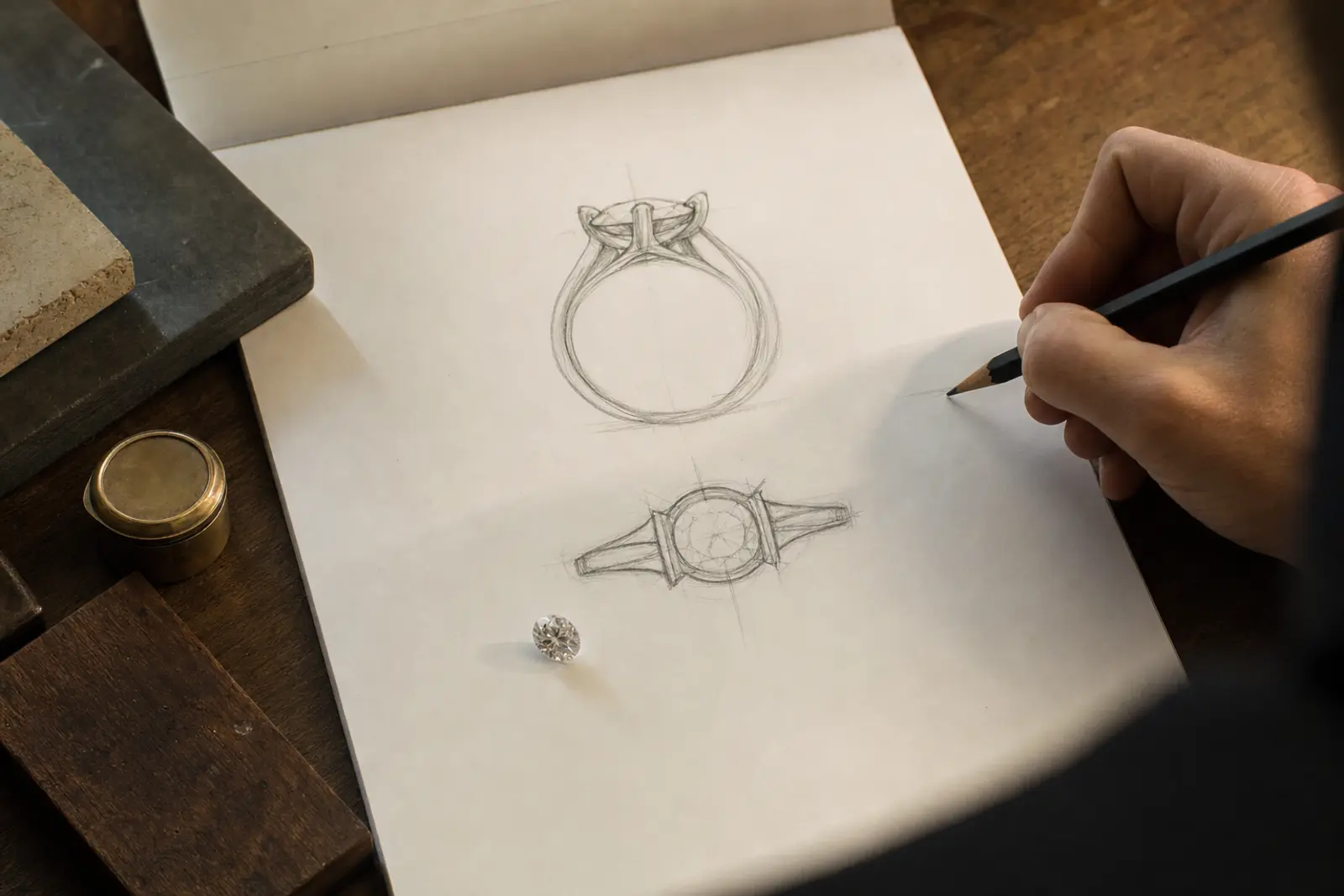
The design process is where a ring goes from a description to a decision: not the sketch itself, but the sequence of questions, trade-offs and small refusals that happen before a single line is approved for CAD.
What Gavin asks, and why
Design starts with questions that have nothing to do with metal or stones. How she uses her hands day to day: whether she gardens, climbs, plays an instrument, works with her hands in a way that puts a ring at risk. What she has said, unprompted, about other people's rings. Whether an existing piece already carries weight in the family. Each answer removes options rather than adding them, which is the point.
A wide setting looks generous in a photograph and catches on everything in daily life. A hand that spends its day on a keyboard tolerates a high setting differently to one that spends it in a garden. None of this is guesswork. It is the reason the same stone can end up in three completely different rings depending on who is wearing it.
Narrowing from references
References rarely arrive as engineering. A client brings a photograph and says she likes the feel of it, not the millimetre count. The design conversation is largely translation: turning "I like how open it feels" into a lower gallery and a narrower halo, or turning "not fussy" into fewer prongs and a plain shank. Two references that look unrelated in a saved folder often turn out to want the same three things.
By the end of this stage there are usually two or three directions, not one. Keeping more than one alive for a round of feedback is deliberate. A direction that looks obviously right on paper sometimes loses to one that looked ordinary until it was set next to the actual stone.
The role of the stone in the design
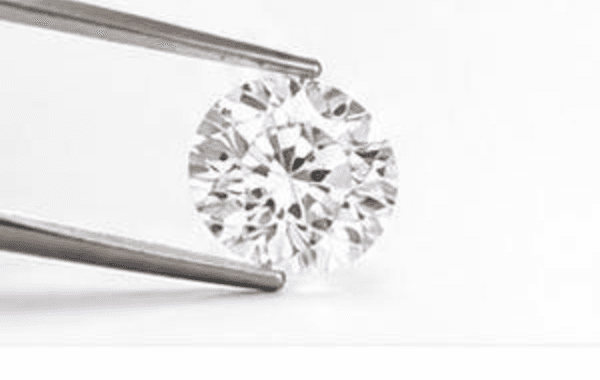
A stone is not decoration added to a finished design. It sets the scale of everything around it: the width a band can be before it overwhelms a smaller stone, how high a basket needs to sit to protect a deep pavilion, how much metal a fancy shape needs at its points to survive daily wear. This is why the stone is chosen inside the design stage rather than after it. A design finished before the stone is found is a guess wearing a ring.
Proportion decisions
Most of the real design work is proportion, not shape. How high the setting sits above the finger. How far the shoulders taper before they meet the band. Whether a halo sits flush with the centre stone or steps down from it. These decisions are argued in millimetres, not adjectives, and they are the difference between a ring that photographs well and one that also survives being worn every day for fifty years.
What you decide, what Gavin decides
You decide how the ring is worn and what it should say: quiet or noticeable, a family stone or a new one, a style she has pointed to or one nobody in her life has seen before. Gavin decides what keeps a stone secure, what a particular metal can and cannot do at a given thickness, and when a shape that looks right on screen will not survive a bench vice, let alone forty years on a hand. Both sides of that split are non-negotiable, for different reasons.
How disagreements get resolved
It happens more often with the second kind of decision than the first. A client wants a knife-edge band under a heavy stone because she has seen it somewhere; the honest answer is that the edge will thin and eventually notch. The resolution is rarely a flat no. It is usually a version of the same idea that keeps the visual effect and moves the risk somewhere the metal can actually carry it, with the reasoning shown, not just the refusal.
When to stop designing
A design is finished when a change would improve one thing and cost another: a slightly higher setting for more sparkle against slightly less daily comfort, a narrower shank for elegance against slightly less strength. Once the conversation is trading one virtue for another rather than fixing a flaw, it is time to send the direction to CAD. Held open past that point, a design does not get better. It gets indecisive.
- Confirm the number before a single sketch is drawn, not after.
- Choose the stone before the setting is finalised, not the other way round.
- Settle proportions in millimetres, not in words like delicate or bold.
- Keep two directions alive until one is tested against the actual stone.
- Stop once a change starts trading one strength for another.
A design is not approved because it is beautiful. It is approved because every millimetre in it has a reason.
How many design directions should I expect to see?
Usually two or three, deliberately different from each other rather than three versions of the same idea. Showing one direction only removes your ability to compare, and showing six creates a decision nobody can make well. Two or three distinct approaches, each with an honest account of what it trades off, is enough for most people to recognise the right one quickly, sometimes within the same conversation.
What if I cannot decide between two directions?
That is common, and it is not a problem to solve quickly. Sleep on it, and look at both again with the stone in the room rather than on a screen. If you are still torn after that, the honest signal is that both directions are genuinely good, and either one, competently made, will suit you. The design stage exists to remove weak options, not to manufacture a single obvious winner every time.