A weather-backup plan is not a marquee mentioned in passing on the tour, it is a second version of the wedding day, and it deserves the same scrutiny as the version everyone hopes for: who decides to use it, by when, and what the guests will actually experience if it is called.
More than a marquee promise
Many venues answer the weather question with a gesture toward a tent, a covered veranda or an indoor hall, without saying much more. Ask what that space actually looks like set for your guest number: the seating layout, whether the dance floor and band still fit, and whether it is a slightly smaller version of the day or a meaningfully different one. A backup that only works for half the guest list is not a backup.
Who decides, and by when
Ask the venue directly who makes the call to move to the backup plan, whether that is the couple, the planner or the venue's own management, and by what point on the day that decision has to be made. A late call gives suppliers less time to reset lighting, sound and catering; an early call risks moving indoors on a day that clears by four o'clock. Get the decision process and the cut-off time in writing rather than leaving it to whoever happens to be checking the sky.
Lighting and sound in the backup space
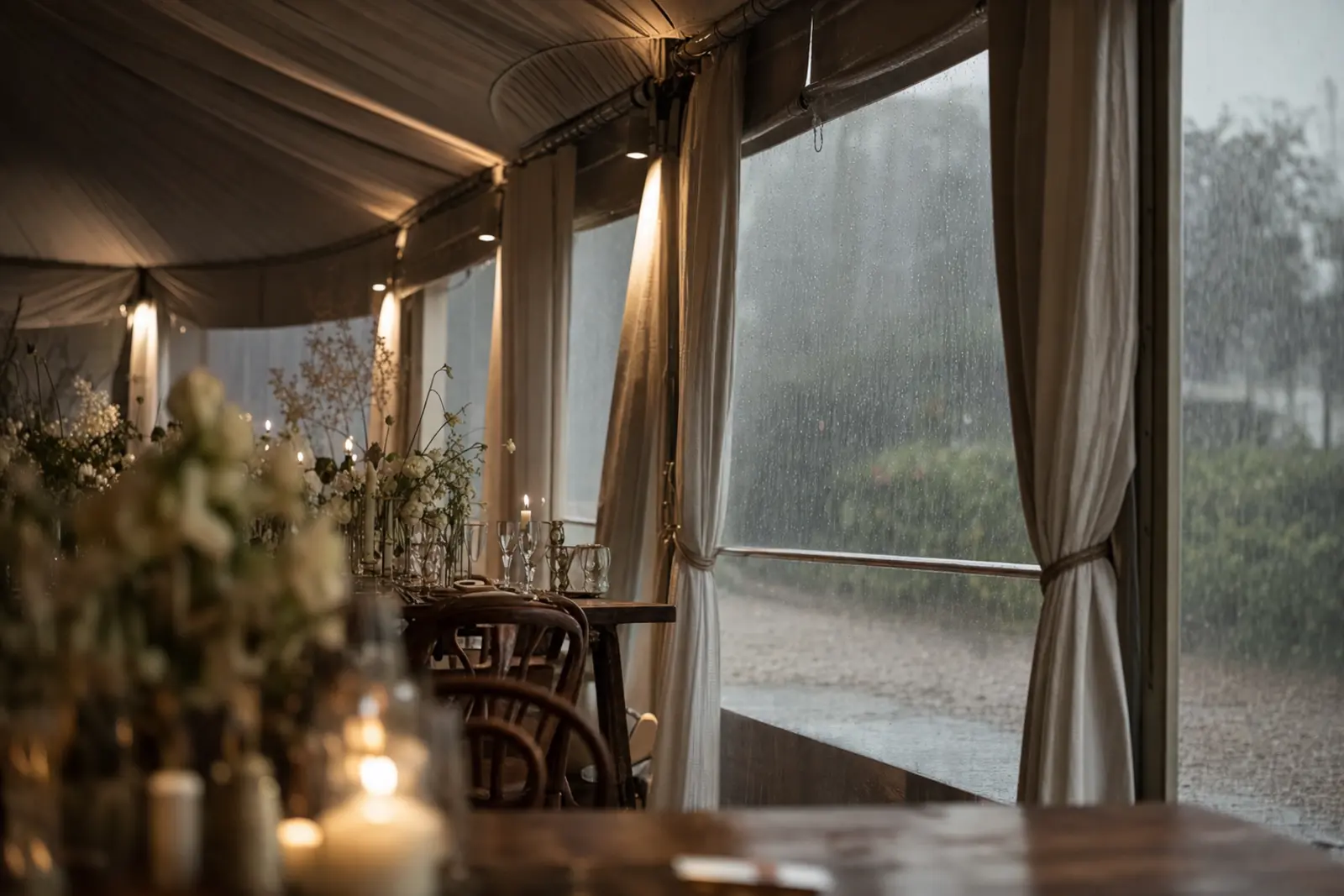
A backup room often has different ceiling heights, different acoustics and a different relationship to natural light than the primary space, and none of that shows up in a conversation about seating numbers alone. Ask how the room is lit once the sun goes down inside it, and whether the sound system that works in the garden also works, unmodified, in the hall. A ceremony moved indoors at the last minute with borrowed lighting and a single speaker feels like a compromise; the same ceremony planned for indoors from the start does not.
- Ask to see the backup space set for your actual guest number, not described in general terms.
- Confirm who decides to activate the backup plan, and the cut-off time on the day.
- Ask whether the dance floor, stage and bar all still fit in the backup space.
- Check the lighting and sound plan for the backup space specifically, not only the main one.
- Ask how quickly the changeover can happen if the call is made late in the day.
Regional weather worth planning around
On the Highveld, the risk in summer is usually a short, hard afternoon storm rather than a whole wet day, so an early-evening ceremony can often still go ahead outdoors if the backup only needs to cover an hour or two. On the coast, humidity and the chance of longer rain bands change that calculation, and a Cape Town wedding has the wind to plan around as much as the rain. None of this replaces asking the specific venue what it has seen on past dates around your own; ask, rather than assume the season decides it for you.
A weather backup you have already pictured is the difference between a calm change of plan and a ruined one. The point of asking these questions early is that you never have to ask them in the rain.
How late can a venue usually make the call to move indoors?
This varies by venue and depends on how much resetting the backup space needs. Some can make the call an hour or two before the ceremony; others, particularly if the backup involves moving furniture or catering equipment, need most of the day. Ask for the specific cut-off time in writing rather than a general answer, and build your own morning-of schedule around it so your photographer, planner and family know when a decision is expected.
Does a weather backup cost extra?
Sometimes, and it is worth asking plainly rather than assuming it is included. Some venues include the backup space in the base booking; others charge for the marquee, heating, additional staff time or the labour of resetting the room. Ask for this in writing at the same time you confirm capacity and catering, so it is part of the contract rather than a surprise on the invoice.