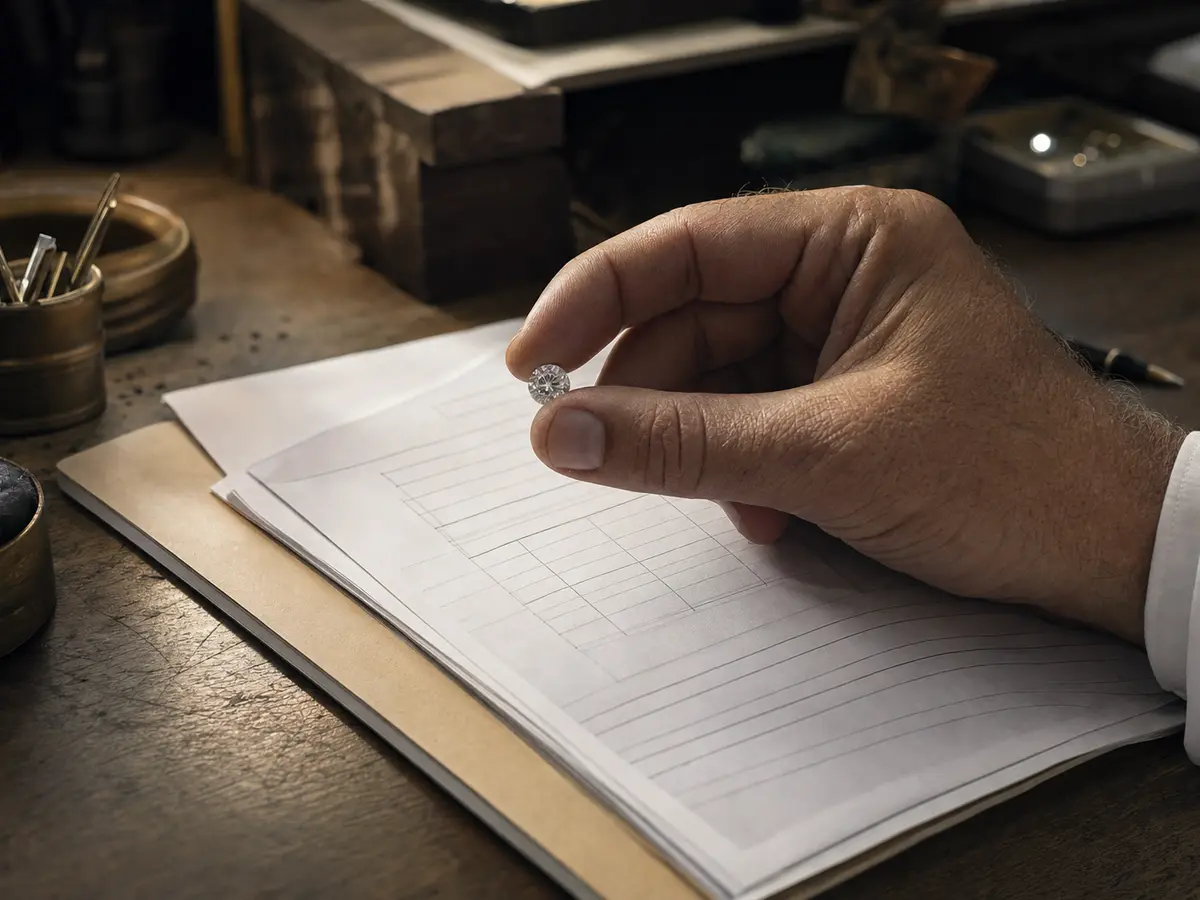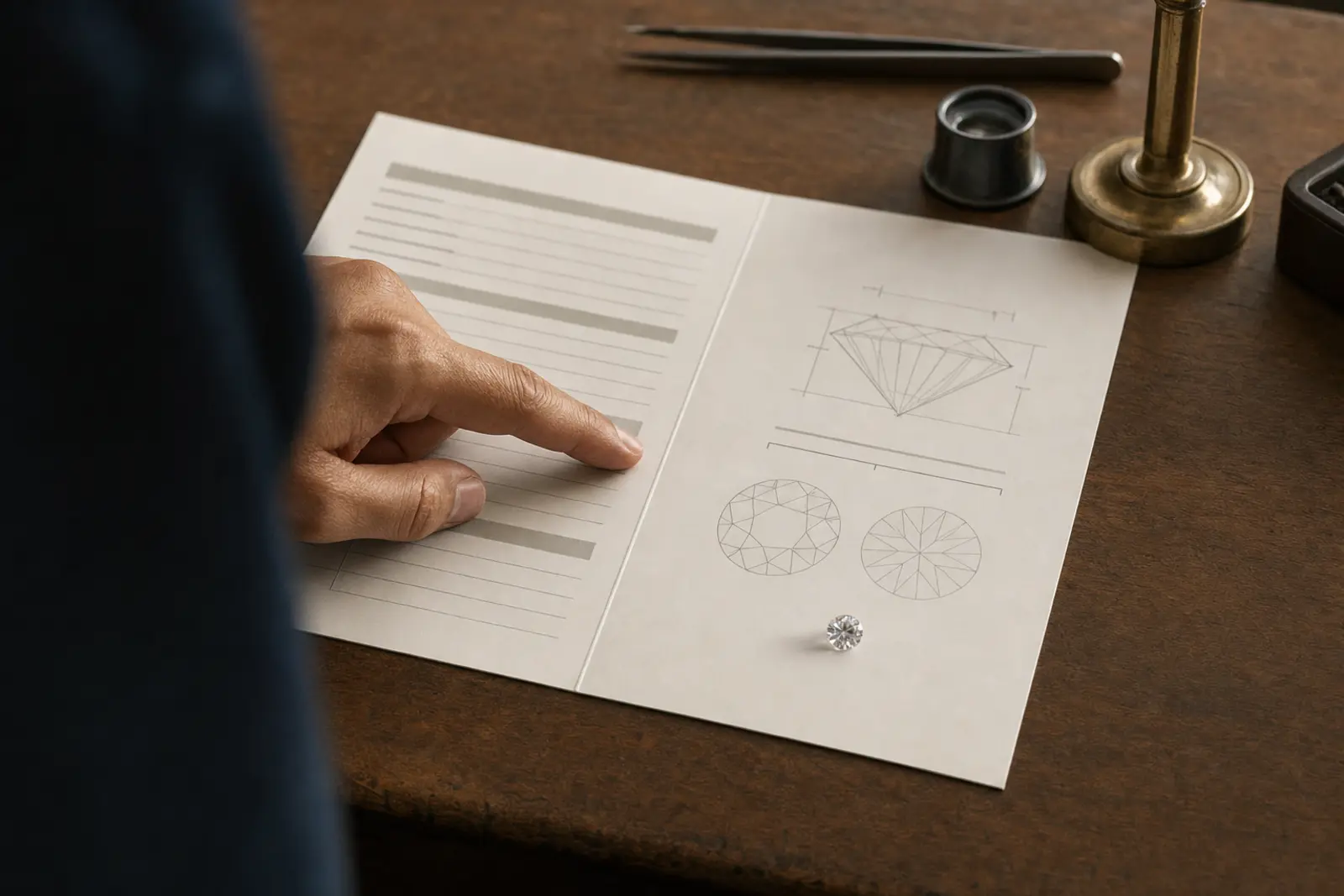
A grading report is a factual description of a diamond written by an independent laboratory: what shape it was cut into, what it weighs, and where its colour and clarity fall on a fixed scale, nothing more.
What a report is, and who writes it
A major international laboratory examines a diamond that has already been cut and polished, and writes down what it finds. It does not grade beauty and it does not set a price; both of those are separate judgements a report was never built to make.
The report exists to describe the stone consistently, so that two people in two different cities can talk about the same diamond without seeing it. That is a genuinely useful thing. It is also a narrower job than most people assume when they first read one.
The report, line by line
Every report runs in roughly the same order. Here is what each line is actually telling you.
- Shape and cutting style
- The outline, round, oval, cushion and so on, and whether the facet pattern is brilliant or step cut.
- Measurements
- Length, width and depth in millimetres, the numbers that decide how large a stone looks face-up.
- Carat weight
- The stone's weight, to the hundredth of a carat, not a measure of size on its own.
- Colour
- A letter from D to Z, judged against a master set under controlled light.
- Clarity
- A grade from Flawless down through the Included grades, describing what a trained grader sees under magnification.
- Cut grade
- Issued only for round brilliants, from Excellent to Poor. Fancy shapes are left blank and must be judged by eye.
- Polish and symmetry
- How cleanly the facets were finished and how precisely they line up with one another.
- Fluorescence
- Whether the stone glows under ultraviolet light, and how strongly, most often a shade of blue.
- Plotted diagram
- A map of where the inclusions actually sit inside the stone, using standard symbols for feathers, crystals and clouds.
- Inscription
- A number laser-inscribed on the girdle, invisible without magnification, matching the report.
- Comments
- Additional notes a standard grid cannot capture: an unusual inclusion, an indented natural, a laser drill line.
None of these lines exist in isolation. A stone with a strong colour and clarity grade but only a Good cut grade is a different proposition to one with a slightly lower colour and an Excellent cut, and reading the report as a set rather than line by line is the more useful habit to build. This is particularly true for a fancy shape carrying no cut grade at all, where the other lines on the report tell you nothing about how the stone actually performs and the inspection in person does the work the report cannot.
What the report does not tell you
It does not tell you whether the stone is beautiful. A fancy shape carries no cut grade at all, and even a round brilliant's grade describes proportions, not how the stone actually performs in front of you. It does not set a price; that is decided by the market on the day you buy, not printed on the paper.
It is also not a valuation. A report describes what the stone is. A valuation states what it would cost to replace, prepared separately and usually including the setting and the metal. Insurers generally ask for the valuation, not the report alone, and the two documents answer different questions.
Comparing reports from different laboratories
Not every laboratory grades to the same tolerance. Reports from less rigorous laboratories are sometimes a full grade or two softer than the major international laboratories, which means a stone that looks like a bargain on paper may simply be described generously. This matters most when you are weighing two stones against each other.
Compare like with like. Where possible, use reports from laboratories of comparable standing, and treat a report from an unfamiliar laboratory as a starting point rather than a settled fact until the stone has actually been looked at.
Treat the report as the start of the conversation rather than the end of it. Once the facts are settled, the only test that matters is whether the stone earns its grade in front of you, in more than one light.
A report tells you what a stone is. It has never once told me whether a particular client should buy it.
Can two diamonds with identical report numbers look different from each other?
Yes, and it surprises people. Two stones graded G colour and VS1 clarity by the same laboratory can still differ in how they perform, because the report does not capture cut quality on anything but round brilliants, and it says nothing about how the inclusions are arranged or where the colour sits across the table. The numbers narrow the field. They do not replace looking at the stone itself, ideally next to another candidate, before you decide.
Is a diamond report the same thing as an insurance valuation?
No, and the two are often confused. A report from a major laboratory records what the stone is: its shape, weight, colour, clarity and the rest. A valuation is a separate document that states what it would cost to replace the piece, prepared specifically for insurance and usually including the setting and the metal. You need both for a serious purchase, but one does not stand in for the other, and an insurer will generally ask for the valuation, not the grading report alone.