Plan a proposal in the order the studio actually sees it work: the idea first, then how long the ring will take, then the setting, then the people who need to know, then the day itself, and only at the end the exact words. Working backwards from a fixed date rarely holds together.
The order that actually works
The plan holds together when each decision is made in roughly the right order rather than all at once. Decide first whether a full surprise suits the two of you, or whether she would rather be in on it. Decide the ring timeline second, because it is the slowest-moving part of the whole plan and it sets a floor under every date that follows. Decide the setting third, once you have a realistic sense of when the ring will be ready, and decide who else needs to know only after that. The words come last, and they come easier once everything above them is settled.
Start with the ring, because it moves slowest
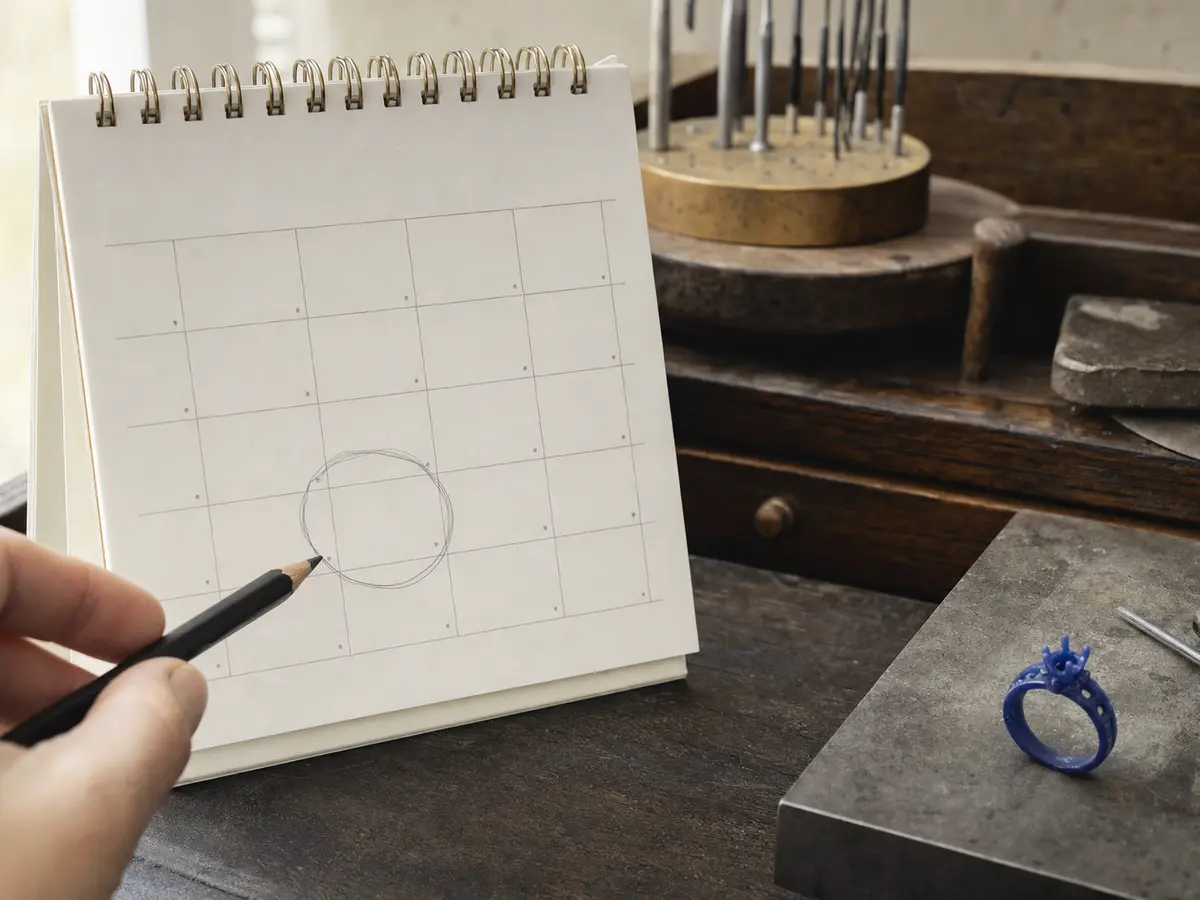
A ring that already exists in the right size can be ready within days. A ring designed from a chosen stone and a sketch takes longer, sometimes a good deal longer, once the stone has been sourced and approved and the piece has been made and finished properly. Ask Gavin for a realistic timeline before a date is fixed in your head, not after. Working backwards from the ring, rather than trying to make the ring fit a date already chosen, is the single change that saves most proposals from being rushed at the end.
Choose the setting once you know who is in the room
A setting is a smaller decision than it feels like at the start. It only has to do three things properly: hold the two of you somewhere private, give you somewhere to sit down together straight afterwards, and suit however many other people, if any, are going to be nearby. Settle the guest question before booking anything, because a setting chosen for two people and a setting chosen for twenty are rarely the same place, and rebooking a venue a week out is an avoidable scramble.
The plan, step by step
- Decide, between the two of you if it is a joint decision, whether this will be a full surprise, a known-but-unscheduled proposal, or one you plan together.
- Talk to Gavin about the ring and ask for an honest timeline rather than a hopeful one, then build the date around it.
- Choose a setting that passes three tests: privacy, somewhere to sit afterwards, and a guest list that matches what has actually been decided.
- Decide who, if anyone, needs to know in advance, and tell them only once the date is close enough that a secret does not have to survive weeks.
- Arrange a photographer if you want one, briefed to work from a distance with a long lens, or decide deliberately to have no photographs at all.
- Work out where the ring will be carried on the day and who is responsible for it right up until it is needed.
- Plan the hour after the question: where the two of you go, who gets called first, and when the ring gets its first proper look in daylight.
- Book the fitting and the first proper design or valuation conversation for the days immediately afterwards, so momentum carries you into it.
The week before
Most proposals that go wrong go wrong in the last few days, not on the night itself. Confirm the setting still exists as pictured: restaurants change tables, gardens close for private events, and Highveld or coastal weather turns with little warning. Confirm the ring is actually in your hands and not still at the studio. Confirm that anyone who knows still needs to know, and has not mentioned it to somebody who was never supposed to hear.
- The ring is collected, checked, and carried in a case, not loose in a pocket.
- The setting has been checked in person in the last week, not just booked weeks ago.
- A weather and power back-up exists if any part of the plan depends on either.
- Anyone who knows has been told when, so nobody arrives early or lets it slip.
- A photographer, if there is one, has a written brief and a distance to shoot from.
- You know roughly what you want to say, without having memorised a script word for word.
- A plan exists for the hour afterwards: where you go, and who hears the news first.
The part people skip
The studio sees far more proposals unsettled by a rushed ring or an unchecked venue than by nerves on the night itself. Build the plan around the two slow-moving parts, the ring and the setting, and the rest of it tends to arrange itself in the days that follow.
A good plan is not a complicated one. It is a short list, done in the right order, with enough time left in it for the ring.
How long before the proposal should I start planning?
Start as soon as you know you want to propose, even if the date itself is months away, because the ring is normally the slowest part of the whole plan. A ring already close to the right size and style can be ready quickly. A ring built from a chosen stone and a new design takes longer, so a short conversation with Gavin early on tells you what is realistic and stops the date being fixed before the ring can support it.
Do I need a professional planner to organise a proposal?
No, most proposals need a handful of decisions made calmly and in the right order, which two people can manage themselves with a checklist. A proposal planner tends to earn their fee at the more elaborate end of the scale: several locations in one day, a large hidden guest list, or logistics that genuinely need a second pair of hands. For a private proposal for two, it is rarely necessary.
What is the single biggest mistake people make when planning a proposal?
Fixing the date first and trying to make the ring fit it. The ring, particularly anything made rather than bought off a shelf, sets the earliest sensible date, not the other way round. The next most common mistake is choosing a setting before deciding who, if anyone, will actually be there, which usually means rebooking once the guest question finally gets answered.